You have probably heard the word Hafiz used to describe someone who “has memorized the Quran,” but the term carries a bit more meaning and responsibility than that short description suggests. Here is what it actually means, and what the path to becoming one looks like in practice.
Direct answer: A Hafiz (female form: Hafiza) is a person who has fully memorized the entire Quran, all 604 pages and over 6,000 verses across 114 surahs, and is able to recite it accurately from memory without reading from a text. The word comes from the Arabic root meaning “to guard” or “to preserve,” reflecting the role a Hafiz plays in preserving the Quran’s exact wording across generations.
Where the Word Hafiz Comes From
Hafiz is an Arabic word that literally means “guardian” or “preserver.” It is used in this context because a person who memorizes the entire Quran is, in a real sense, carrying and preserving its exact wording in living memory, independent of any written copy.
This tradition predates the widespread availability of printed books and has continued since the Quran was first revealed, as a way of ensuring its exact text remains unchanged across generations.
What Becoming a Hafiz Actually Requires
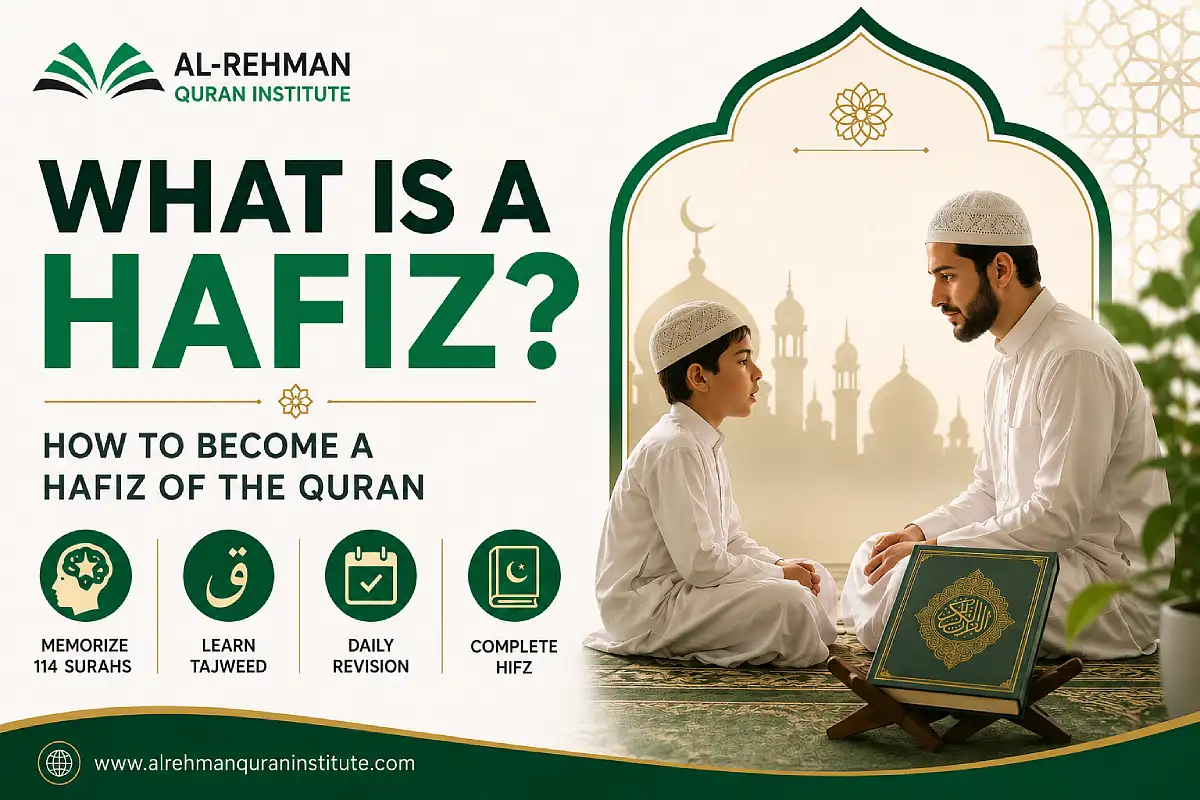
Becoming a Hafiz means memorizing the complete Quran, not just familiar or shorter portions. This includes:
- All 114 surahs, ranging from just 3 verses (the shortest) to 286 verses (the longest)
- Correct pronunciation and recitation rules, known as tajweed
- The ability to recite accurately without a text in front of you, including being able to continue from any point in the Quran if asked
This is different from simply being familiar with the Quran or knowing many of its shorter chapters. A Hafiz has memorized every single verse, in order, and can recite any requested portion from memory.
For beginners, starting with shorter surahs can make the memorization journey more manageable. Read our Easy Surahs to Memorize for Beginners.
How to Become a Hafiz of the Quran
The path to becoming a Hafiz generally follows the same core method used for any Quran memorization, just sustained across the full length of the Quran rather than a partial goal:
- Build strong Arabic reading fluency first, or alongside early memorization, since reading comfortably speeds up the whole journey considerably.
- Memorize daily in small, consistent portions, commonly starting around a quarter page and building up to a full page or more per day as consistency and confidence grow.
- Pair every session with revision, both of recent memorization and a rotating cycle through everything memorized previously, since this is what prevents earlier portions from fading as new ones are added.
- Recite regularly to a teacher or qualified reciter, who can catch small pronunciation and tajweed errors before they become deeply memorized habits that are much harder to correct later.
- Complete the full cycle, typically taking anywhere from 1 to 5 years depending on daily pace, prior Arabic fluency, and whether memorization is full-time or part-time.
Book Your Quran Class
Select your course below to schedule your free live trial.
Common Paths to Becoming a Hafiz
- Hifz school or madrassa programs, often for children, structured around several hours of daily memorization and revision, typically completing the full Quran in 2 to 4 years.
- Residential intensive programs for adults, where memorization is the sole daily focus, sometimes completing in under 2 years.
- Part-time self-study or with a tutor, fitting memorization around work, school, or family responsibilities, generally taking 3 to 5 years or longer.
None of these paths is inherently “more valid” than another. What matters for actually becoming a Hafiz is complete, accurate memorization of the entire Quran, regardless of which structure got you there.
Start Your Hifz Journey With Us Now.
Life After Becoming a Hafiz
Completing full memorization is not the finish line in the way it might sound. A Hafiz still needs ongoing revision to keep the entire Quran solid in memory, since 604 pages of memorization can fade without regular reinforcement, exactly like any smaller portion would.
Many Hafiz continue a structured revision cycle for years afterward, often reciting large portions in prayer or dedicated revision sessions to keep the memorization from weakening over time.
Some Hafiz go on to lead prayers, particularly during Ramadan when longer portions of the Quran are recited nightly, while others use their memorization purely in their personal worship and family life without any formal teaching or leading role. Both are complete and valid outcomes of the same achievement.
Frequently Asked Questions
What is the difference between a Hafiz and someone who has memorized a few surahs?
A Hafiz has memorized the complete Quran, all 114 surahs in full. Someone who has memorized a handful of shorter surahs, even if it is a meaningful personal achievement, is not referred to as a Hafiz, since the term specifically denotes complete memorization.
Can anyone become a Hafiz, or does it require special talent?
Becoming a Hafiz does not require any unusual natural ability. It requires consistent daily memorization and revision sustained over a long period, which is why people of widely varying backgrounds, ages, and starting points successfully complete it every year.
Is there an age limit to becoming a Hafiz?
No. Children as young as 5 or 6 begin structured memorization programs, while adults in their 30s, 40s, and beyond regularly complete full memorization as well. Age affects pace and available daily time more than it affects whether someone can become a Hafiz at all.
Do Hafiz still need to revise the Quran after completing memorization?
Yes. Ongoing revision is essential even after completing full memorization, since forgetting can happen to any memorized material, including the Quran, without regular reinforcement. Most Hafiz maintain some form of structured revision routine indefinitely.