The Five Pillars of Islam: What They Are, Why They Matter, and How Muslims Practice Them
Every Muslim’s daily life rests on five specific obligations. Most articles just list the five words and move on, so you’re left knowing the names but not how they actually work together.
Direct Answer: The Five Pillars of Islam are the five core acts of worship every Muslim is required to perform: Shahada (declaring faith in one God and Muhammad as His messenger), Salah (praying five times a day), Zakat (giving 2.5% of savings to those in need), Sawm (fasting during Ramadan), and Hajj (pilgrimage to Mecca once in a lifetime, if able). Together they form the practical framework of Islamic worship, the structure that turns belief into daily action.
What Are the Five Pillars of Islam?
The Arabic word usually translated as “pillar” is rukn, which literally means the corner of a building, the structural point that holds everything else up. Some scholars argue “five principles” is actually a more accurate English translation than “five pillars,” since these aren’t decorative columns. They carry real weight.
The five pillars come from a specific, well-known source: the Hadith of Gabriel (Jibril), a narration recorded in Sahih Muslim and Sahih Bukhari. In it, the Angel Gabriel appears to the Prophet Muhammad in human form and asks him to define Islam. The Prophet’s answer (testifying to God’s oneness, praying, giving charity, fasting Ramadan, and making the pilgrimage) became the five pillars as Muslims recognize them today.
It’s worth noting these are pillars of action. There’s a separate, related concept, the six pillars of Iman (faith), that covers what a Muslim believes rather than what a Muslim does. We’ll unpack that distinction later, since it’s one of the most commonly confused points in this topic.
The Five Pillars of Islam in Order
The order isn’t arbitrary. It moves from internal conviction outward to physical action, and from daily practice to a once-in-a-lifetime act.
# | Pillar | Arabic | Literal Meaning | What It Involves |
1 | Faith | Shahada | Testimony | Declaring “There is no god but Allah, and Muhammad is the messenger of Allah” |
2 | Prayer | Salah | Connection | Praying five times daily, facing Mecca |
3 | Charity | Zakat | Purification | Giving roughly 2.5% of savings annually to those in need |
4 | Fasting | Sawm | Restraint | Abstaining from food, drink, and other physical needs from dawn to sunset during Ramadan |
5 | Pilgrimage | Hajj | Journey | Traveling to Mecca at least once, if physically and financially able |
Here’s the logic behind that sequence: you can’t pray sincerely without first believing (Shahada comes first). Once belief is established, prayer disciplines the individual daily. Zakat extends that discipline outward to the community. Sawm strips away comfort so the believer feels what deprivation is like. Hajj is the capstone, a physical, once-in-a-lifetime act that brings the previous four together into a single journey.
Join our online Quran recitation classes for kids and adults to build a strong reading foundation.
1. Shahada — The Declaration of Faith
Shahada is the sentence that makes someone a Muslim. In Arabic: lā ʾilāha ʾillā-llāh, muḥammadun rasūlu-llāh, meaning “There is no god but Allah, and Muhammad is the messenger of Allah.”
It has two halves, and both matter. The first denies any partner or equal to God (tawhid). The second confirms Muhammad as God’s final messenger. Muslims recite it silently within every prayer, and traditionally it’s the first phrase whispered into a newborn’s ear and the last words a Muslim tries to say before death. A sincere, conscious recitation, one that’s understood and believed, not just spoken, is what formally brings someone into Islam.
2. Salah — The Five Daily Prayers
Salah is prayer performed five times a day at fixed windows: Fajr (dawn), Dhuhr (early afternoon), Asr (late afternoon), Maghrib (just after sunset), and Isha (night). Each prayer is preceded by wudu, a ritual washing of the hands, face, arms, and feet. Prayer itself is performed facing the Kaaba in Mecca.
Salah isn’t just recitation. It involves a set sequence of standing, bowing, and prostration, structured around specific Quranic verses. It’s the pillar practiced most frequently, which is why many scholars describe it as the daily “checkpoint” that keeps the other four pillars anchored.
Exemptions: Women during menstruation are excused from the ritual prayer itself, though not from remembering God more generally. Those who are seriously ill may pray sitting or lying down, adapting the physical movements as needed.
3. Zakat — Purifying Wealth Through Charity
Zakat literally means “purification.” The idea is that wealth itself isn’t the problem. Hoarding it, without giving any share back, is. Eligible Muslims give roughly 2.5% of their savings and qualifying assets each year, once those assets exceed a minimum threshold called nisab (commonly calculated against the value of about 87.48 grams of gold or 612.36 grams of silver).
Zakat is distinct from sadaqah, which is voluntary charity given at any time in any amount. Zakat is obligatory, calculated, and typically distributed to specific categories of recipients defined in the Quran, including the poor, those in debt, and travelers in need.
4. Sawm — Fasting During Ramadan
Sawm is fasting through the ninth month of the Islamic lunar calendar, Ramadan. From dawn to sunset, healthy adult Muslims abstain from food, drink, and marital relations. Because the Islamic calendar is lunar, Ramadan shifts about 11 days earlier each Gregorian year.
The stated purpose, according to the Quran (2:183), isn’t hunger for its own sake. It’s about building self-restraint and genuine empathy for people who don’t have enough food or resources every day.
Exemptions: Prepubescent children, the elderly, those with chronic illness, pregnant or breastfeeding women, menstruating women, and travelers are all exempt. Many are still expected to make up the missed days later, or to provide meals to those in need if fasting isn’t possible at all.
Ramadan closes with Eid al-Fitr, a three-day festival marking the end of the fast.
5. Hajj — The Pilgrimage to Mecca
Hajj is a pilgrimage to Mecca that every Muslim who is physically and financially able must complete at least once in their lifetime. It takes place during Dhul Hijjah, the twelfth month of the Islamic calendar.
Pilgrims enter a state called ihram, a state of ritual purity marked by simple white garments for men. The plain clothing removes visible markers of wealth or class, so pilgrims stand as equals. Core rituals include:
- Tawaf: circling the Kaaba seven times
- Sa’i: walking seven times between the hills of Safa and Marwah
- Standing at Arafat: a day of prayer and reflection, considered the spiritual peak of Hajj
- Ramee: symbolically casting stones at pillars representing temptation, at Mina
Those who genuinely cannot afford the journey, or who are physically unable, are exempt. The Quran specifies the obligation applies only to those who are capable (Quran 2:196, 3:97). Umrah, a shorter pilgrimage that can be performed at any time of year, is a recommended but non-obligatory alternative.
Perfect your pronunciation and master the rules of accurate reading with our online Tajweed classes.
Why the Five Pillars Matter
Strip away the individual definitions and a pattern shows up: each pillar targets a different dimension of a person’s life.
- Shahada anchors belief, the foundation everything else depends on.
- Salah builds daily discipline and a direct, structured connection to God.
- Zakat forces wealth outward into the community instead of letting it stagnate.
- Sawm builds empathy through temporary self-denial.
- Hajj unites the global Muslim community physically, at least once, regardless of nationality or wealth.
Taken together, they’re less a checklist and more a rhythm: daily (Salah), annual (Zakat, Sawm), and lifetime (Hajj), a rhythm that keeps faith from staying purely abstract.
Are There Really Only Five Pillars?
If you’ve seen searches for “6 pillars of Islam” or “7 pillars of Islam” and wondered whether the number changes, here’s the honest answer: it depends which framework someone is referencing.
- Sunni Islam recognizes exactly five pillars, the ones covered above.
- Twelver Shia Islam organizes practice differently. It separates five foundational beliefs (Usul al-Din: God’s oneness, divine justice, prophethood, the imamate, and the Day of Judgment) from ten “Ancillaries of the Faith” (Furu al-Din), which include Salah, Sawm, Zakat, and Hajj alongside additional obligations like Khums (a further wealth tax) and Jihad.
- Ismaili Islam counts seven pillars, adding Walayah (devotion to God and the Imam) and Jihad to the core list, while interpreting some pillars, like Hajj, more symbolically.
So “5” is correct for the overwhelming majority of Muslims worldwide (Sunni Islam), but not a universal number across every school of thought.
Pillars of Islam vs. Pillars of Iman (Faith)
This is where a lot of searches go sideways. People looking for “pillars of faith” often land on five-pillars content when they actually mean something related but different.
Pillars of Islam | Pillars of Iman (Faith) | |
Count | 5 | 6 |
Covers | What a Muslim does | What a Muslim believes |
Examples | Shahada, Salah, Zakat, Sawm, Hajj | Belief in God, His angels, His books, His messengers, the Last Day, and divine decree (Qadar) |
Both come from the same Hadith of Gabriel. Islam (action) and Iman (belief) are treated as two connected but distinct answers the Prophet gave to the same angel, in the same conversation.
Teaching the Five Pillars
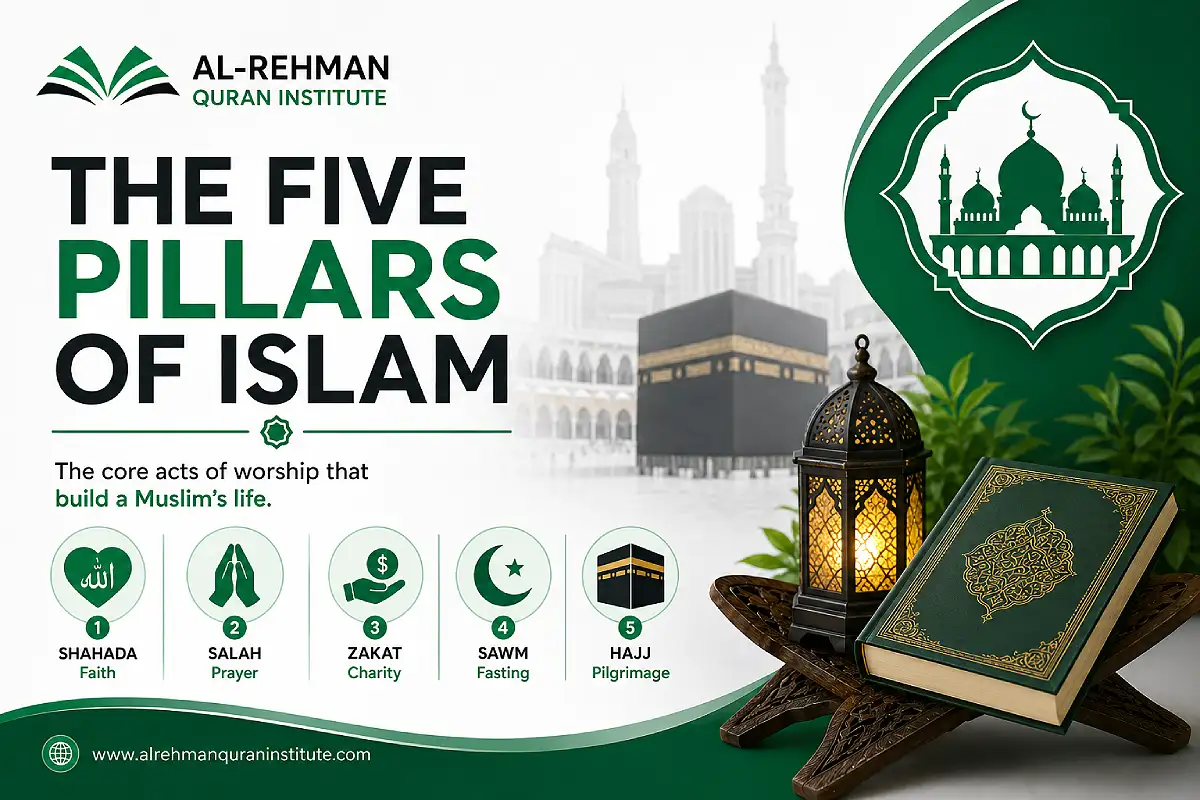
If you’re building a lesson plan, worksheet, or classroom poster around this topic, the order-and-table format above works well as a base structure. Five rows, five colors, and five simple icons, a heart for Shahada, praying hands for Salah, a coin for Zakat, a crescent moon for Sawm, and the Kaaba for Hajj, make up the most common visual shorthand used in Islamic studies materials for children.
Frequently Asked Questions
How many pillars of Islam are there? Five, according to Sunni Islam, which represents the majority of the global Muslim population. Some other traditions within Islam, like Twelver Shia and Ismaili Islam, structure obligations differently and count more.
What are the five pillars of Islam in order? Shahada (declaration of faith), Salah (prayer), Zakat (charity), Sawm (fasting), and Hajj (pilgrimage), moving from internal belief to daily practice to a lifetime obligation.
Which of these is NOT one of the five pillars of Islam? Jihad is the most commonly mistaken answer. It’s a significant concept in Islam, and it does appear in the Shia list of Ancillaries of the Faith, but it is not one of the five Sunni pillars. The five are strictly Shahada, Salah, Zakat, Sawm, and Hajj.
What percentage of wealth is given as Zakat? Roughly 2.5% of a Muslim’s savings and qualifying assets each lunar year, once those assets exceed the nisab threshold.
Are the five pillars mentioned in the Quran? Yes, though not as a single numbered list in one place. Prayer is referenced in verses like 20:130, almsgiving alongside prayer in 5:12, fasting in detail in 2:183–187, and pilgrimage extensively in 2:196–203. The five-pillar framework itself comes from the Hadith of Gabriel, which draws these verses together.
Why are the five pillars important to Muslims? They translate belief into daily, measurable practice. Without them, faith stays a private, internal idea. With them, it becomes a lived structure, something practiced the same way, at the same times, by Muslims worldwide.
What happens if someone can’t complete a pillar, for example, Hajj, due to illness? Islam builds exemptions into nearly every pillar. Hajj is only obligatory for those who are physically and financially able. Fasting has exemptions for illness, pregnancy, and travel. Prayer can be adapted in physical form for the sick. The obligation is tied to capability, not blind requirement.
Is there a common crossword answer for “one of Islam’s five pillars”? Usually yes. Check the letter count in your grid to see which one fits. HAJJ (4 letters) and ALMS (referring to Zakat) are the most frequent crossword answers for this clue, though puzzles occasionally use SALAT or ZAKAT directly.